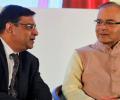
The lack of an informal communication channel is what should bother the government and the RBI, if they want to eliminate the undesirable outcomes of the current tension between the two, says A K Bhattacharya.

The finance minister asked lenders to identify eligible borrowers and reach out to them and urged for quick implementation of a sustained resolution plan for the revival of every viable business.

Banks do extensive investigation before declaring an account fraud; they owe it to us as they deal with our money. Why would they try to fix an innocent borrower? asks Tamal Bandyopadhyay.
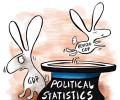
There has been criticism of the official statistics ever since MoSPI came out with new methodology to estimate the GDP on the base year of 2011-12 compared to earlier 2004-05.

Government is framing a rule that will make it compulsory for regulators like Sebi, Irdai and PFRDA to deposit a significant portion of their reserves into the Consolidated Fund of India.

Income tax department sends out notices to cryptocurrency investors on suspicion of tax evasion.
Patel, 55, who took over as the 24th Governor of the central bank on September 5, 2016, had the shortest tenure since 1992.

The Finance Audit and Investment committee recommended 8.95% interest.

There is not much that the RBI can do to address India's inflation. Solutions to the problem lie with Pranab Mukherjee and Sharad Pawar, who run the ministries of finance and agriculture, respectively.

Rajan has a great track record abroad.

Issuance of new bank licences proves that the apex bank wants the financial sector to flourish.
It is also likely to assume a deflator of around 4 per cent. That could take the nominal GDP outlook for FY21 to around 10 per cent. It is this nominal GDP forecast on the basis of which the finance ministry is calculating key Budget targets like the fiscal deficit as a percentage of GDP and tax revenue growth for the coming year.
Going by its past experience of differences between the central bank and the finance ministry, the government might prefer a person who could bridge this gap.

It has been a year since the Reserve Bank of India (RBI) initiated prompt corrective action (PCA), an exercise that puts weak banks under central bank scrutiny, against the 94-year-old Lakshmi Vilas Bank (LVB). But recently, this low-profile Chennai-headquartered bank found itself attracting some unwonted publicity when 60 per cent of its shareholders voted against a proposal to re-appoint seven directors, including one of the promoters, K R Pradeep (who holds around 2 per cent), and the company's managing director & chief executive officer S Sundar.

The appointment will be made by Prime Minister Narendra Modi in consultation with Finance Minister Arun Jaitley.

A K Bhattacharya lists three reasons why Finance Minister Arun Jaitley will most likely present a full Budget on February 1, 2019.

Economists and investors want RBI to retain independence in setting rates

A long crisis with a lack of sound short-term, long-term actions can result in sluggish growth in India, similar to that in Japan.
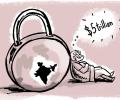
The wait for India to become a $5-trillion economic powerhouse by 2024-25 (FY25) is going to take longer than what the finance ministry had originally intended, according to the International Monetary Fund (IMF). The vision will instead be achieved in 2028-29 (FY29), reveals the IMF data, illustrating a four-year delay. Chief Economic Advisor (CEA) V Anantha Nageswaran had in February said India would become a $5-trillion economy by 2025-26 or the following year, on the back of 8-9 per cent sustained growth rate in real gross domestic product (GDP). However, the IMF data conveys that the economy will be $4.92 trillion in FY28, clearly alluding to the fact that the target will be realised in FY29.

RBI governor Raghuram Rajan is likely to cut rates in next monetary policy.

The finance ministry said the sharp inflows last fiscal were due to the government's policy initiatives and economic recovery.

The finance ministry is not only keen to split the roles of CMD, but also wants to appoint them for a fixed tenure of five years.

Arvind Subramanian was appointed CEA in October 2014 and got a year's extension in September 2017

In a message to public sector banks (PSBs) that only performers will survive, the government, in an unprecedented move, has decided to allocate capital to only nine PSBs.

Banks shall not charge fees for transactions settled on IMPS and UPI in excess of rates charged for NEFT for transactions above Rs 1,000, the order said.

The Bharatiya Janata Party regime will have to make good on this election slogan to restore state-owned banks to health, says Rajiv Lall.

Chief Economic Advisor (CEA) V Anantha Nageswaran on Thursday said describing India's recovery as 'K-shaped' was wrong as both rural and urban economies were recovering, albeit at different paces. Speaking to reporters at the Finance Ministry, Nageswaran said the gross domestic product (GDP) growth print for the recent October-December quarter (Q3FY23) will likely be revised upwards. "The notion of using the letter 'K' to denote urban and rural is somewhat wrong because it is almost as if one is growing and one is contracting. "I would say one segment's slope is more positive, and the other one slope is less positive but it is positive," Nageswaran said.

RBI's draft guidelines prescribe that banks with a strong capital base and NPAs below 3% can become brokers.
.jpg)
The Keynesian advice comes after Finance Minister P Chidambaram has said he considers the fiscal deficit at 4.8 per cent of gross domestic product in 2013-14 as a 'red line'.

According to the data available on the Reserve Bank of India's website, net workers' remittances in April-June 2018 were $11.5 billion

Post office savings of 1, 2 and 3 year term deposits and 5-year recurring deposit currently fetch 8.4 per cent interest per annum.

"We firmly hold that undermining the central bank is a recipe for disaster and government must desist," All India Reserve Bank Association said in a letter. The association said Acharya's comments about the government's interventionist role vis-a-vis the RBI has created a flutter across the nation. "This is, however, not a sudden outburst, but was waiting to happen due to long simmering discontent," the association said.

While foreign currency rating was retained at Baa2 -- the second-lowest investment grade score -- Moody's also projected a fiscal deficit of 3.7 per cent of gross domestic product in the year through March 2020, a breach of the government's target of 3.3 per cent.

Last year this time, India was grappling with an imminent sovereign downgrade, with an uncontrolled fiscal deficit, policy paralysis of the highest order with no economic reforms for eight long years and a weakening rupee.

FinMin does not expect tax or non-tax revenue to reach anywhere close to the targets set in the interim Budget. Sources say that the challenge before the new government will be either to accept the reduced projection and tailor the Budget accordingly or set a more ambitious target.
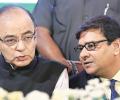
Patel, who headed the RBI from September 2016 till his sudden resignation in December 2018, says in his book thta the government seemed to lose enthusiasm for the new bankruptcy law in the middle of the year he left the central bank. Though Patel does not name anybody in the book, the mid-2018 period he refers to is the time when Piyush Goyal held temporary charge of the finance ministry between May and August.

Green signal from Jaitley; CVC okays Hemant Contractor for head of PFRDA

Now that the economy is growing at a higher-than-expected rate, it is time to accelerate the pace of fiscal consolidation, and the Budget could be a good starting point, argues Rajesh Kumar.

Two senior ministry officials, who declined to be named, said the aim was to attract more capital flows from wealth funds in West Asian countries.
 © 2026 Rediff.com - Advertise with us - Disclaimer - Privacy Policy - Sitemap - Feedback - About us - Terms of use - Grievances